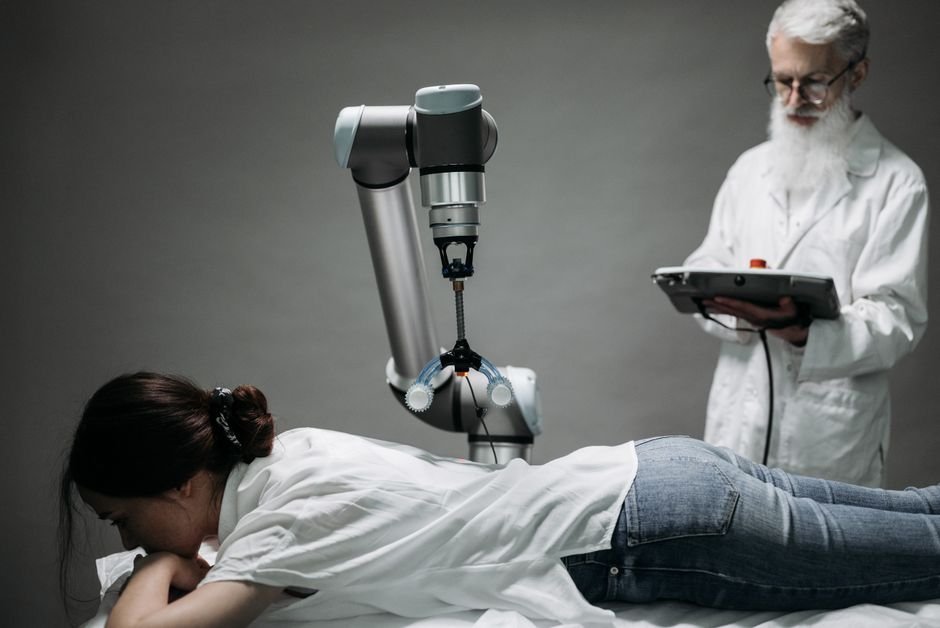
The Critical Need for Embodied Experience in Healthcare Robotics
The central development is this: The future of healthcare promises revolutionary advancements through robotics, from precision surgery to diagnostic assistance. However, a significant hurdle stands in the way of widespread adoption: the scarcity of real-world training data.
Table of Contents
- The Critical Need for Embodied Experience in Healthcare Robotics
- What Exactly is Physical AI?
- Nvidia’s Solution: The Medical Physics Simulation Framework
- How the Framework Works: A Hybrid Approach
- Early Adopters and Real-World Applications
- The Open-Source Advantage for Healthcare Robotics
- Looking Ahead: The Path to Clinical Deployment
- Expert Perspective
- Frequently Asked Questions
- The Data Dilemma in Healthcare
- Accelerating Development, But Questions Remain
- Why does Healthcare Robotics AI Simulation matter right now?
- What broader change could Healthcare Robotics AI Simulation signal?
- What should the market watch next around Healthcare Robotics AI Simulation?
Unlike traditional AI models that learn from vast datasets of text or images, healthcare robots, as ‘physical AI’ systems, require embodied experience – understanding how their actions interact with the physical world through touch, force, and consequence. Nvidia is pioneering a solution to this challenge with its innovative Medical Physics Simulation framework.
What Exactly is Physical AI?
Meanwhile, The term ‘Physical AI,’ embraced by Nvidia and the broader robotics industry, describes intelligent machines that learn through direct interaction with their environment. Imagine a robot learning to navigate a patient’s anatomy: it needs to understand the resistance of a vessel wall, the delicate pressure required for soft tissue, or how a catheter bends under specific conditions.
This kind of learning is fundamentally different from a language model processing text. It demands either extensive physical interaction in the real world or a highly detailed simulation that can replicate such experiences.
The Data Dilemma in Healthcare
For healthcare robotics, obtaining this crucial embodied experience is incredibly difficult. Real-world surgical procedures are rare, tightly regulated, and offer a limited range of scenarios.
It would take years of clinical exposure for a robot to encounter the myriad of edge cases and nuanced interactions it needs to master. This data scarcity severely hampers the development and deployment of truly autonomous and reliable medical robots.
Nvidia’s Solution: The Medical Physics Simulation Framework
In practical terms, Nvidia’s Medical Physics Simulation framework is designed to computationally generate the embodied experience that healthcare robots desperately need. Released as an open-source addition to the company’s Isaac for Healthcare platform, this framework allows developers to simulate complex physical interactions that would otherwise require immense clinical exposure.
Consider scenarios like a guidewire catching on a calcified vessel, a kidney stone lodged at an unusual angle, or specific soft-tissue responses that only appear in a fraction of procedures. These critical ‘edge cases’ don’t arrive on a convenient schedule in an operating room. Simulation allows developers to generate them on demand, accelerating the learning process without putting patients at risk.
How the Framework Works: A Hybrid Approach
For example, The power of Nvidia’s framework lies in its dual approach to modeling device behavior within the human body:
- Classical Physics Simulation: This component handles the well-understood mechanical rules, such as how a catheter bends, the resistance of a vessel wall, or how contact forces shift as an instrument moves through tissue.
- Generative AI: Addressing the harder-to-code aspects, generative AI learns visual scene dynamics from procedural data. This is delivered through a component Nvidia calls Cosmos-H Dreams, which provides the visual and anatomical variation needed for robots to generalize their learning.
This combination is the essence of the physical AI proposition. Classical simulation provides the fundamental physics that a robot’s policy must obey, while generative simulation offers the rich, varied visual and anatomical data needed for robust generalization. When run at scale on GPUs using Nvidia’s Warp and Newton libraries, the framework can execute numerous parallel training environments simultaneously, dramatically cutting down training time.
Accelerating Development, But Questions Remain
That said, Nvidia has demonstrated impressive throughput, with benchmarks showing training time reduced from over five hours to under two minutes when running 8,192 parallel environments. While this showcases a significant advance in how quickly developers can explore failure modes, it’s crucial to distinguish throughput from clinical reliability.
A language model that underperforms on an edge case produces a bad answer, but a physical AI system that underperforms on an edge case is operating inside a patient.
Interestingly, The critical question remains whether these simulated failure modes accurately match what can go wrong in a real surgical suite, especially when dealing with incomplete imaging, delayed sensor readings, or anatomies outside the simulation’s initial model.
Early Adopters and Real-World Applications
Several organizations are already leveraging Nvidia’s physical AI approach, applying it at different stages of development:
- CMR Surgical and Cambridge Consultants: These partners have contributed nearly 500 hours of anonymized clinical data from the Versius Surgical Robotic System to the Open-H Embodiment dataset. They are using Cosmos-H Dreams to model soft-tissue interaction physics and create patient-specific simulations for procedures like cholecystectomy and hysterectomy.
- Johnson & Johnson MedTech: Utilizing the framework with a Cosmos-based foundation model, they are building a digital twin of their endoluminal MONARCH platform, specifically focusing on kidney-stone scenarios in urology.
- XCath: This company is applying the framework to train endovascular autonomy policies, teaching systems the physical behavior required to navigate blood vessels without direct human control.
- Inner Logic: They are generating synthetic data to validate device mechanics and aim to produce in silico evidence to support regulatory submissions.
- Medtronic Structural Heart: At an earlier stage, they are exploring simulated X-ray sensing for catheter navigation research.
However, Notably these are currently training exercises or data contributions. Nvidia explicitly states that none of these represent deployed systems operating on patients with policies learned solely through this method.
The Open-Source Advantage for Healthcare Robotics
Healthcare robotics faces stringent governance requirements that many other physical AI applications, like industrial robots, do not. Regulators and clinical review boards demand transparency: they need to understand precisely how a system arrived at its behavior, not just confirm its performance in testing.
Meanwhile, An open-source framework addresses this by allowing developers and outside reviewers to inspect the underlying physics assumptions, reproduce results across diverse anatomies, and build a robust evidence trail suitable for regulatory bodies like the FDA. While open code enhances transparency, it doesn’t automatically validate that the model’s simulated physical behavior perfectly matches real-world biological interactions. That crucial confirmation still requires rigorous physical testing, which these companies are actively pursuing.
Looking Ahead: The Path to Clinical Deployment
Nvidia’s Medical Physics Simulation framework represents a significant leap in accelerating the pre-hardware development phase for surgical and diagnostic robots. By enabling parallel, scaled training environments, it moves beyond the laborious process of rebuilding custom simulations for every workflow. While the journey from simulated training to clinical deployment is complex and demands thorough validation, this innovative approach is laying the groundwork for a new era of safer, more capable healthcare robotics.
Expert Perspective
From an industry angle, the clearest signal around Healthcare Robotics AI Simulation is how it may influence physical. The story reads less like a one-day spike and more like a marker of broader movement.
The next phase will depend on how quickly teams, regulators, or customers react. In practice, that gives Healthcare Robotics AI Simulation room to reshape expectations across nvidia over the near term.
For readers focused on practical impact, the best next step is to watch what changes around simulation once attention turns into execution.
Frequently Asked Questions
Why does Healthcare Robotics AI Simulation matter right now?
The Critical Need for Embodied Experience in Healthcare RoboticsThe central development is this: The future of healthcare promises revolutionary advancements through robotics, from precision surgery to diagnostic assistance.
What broader change could Healthcare Robotics AI Simulation signal?
However, a significant hurdle stands in the way of widespread adoption: the scarcity of real-world training data.Unlike traditional AI models that learn from vast datasets of text or images, healthcare robots, as ‘physical AI’ systems, require embodied experience – understanding how their actions interact with the physical world through touch, force, and consequence.
What should the market watch next around Healthcare Robotics AI Simulation?
Nvidia is pioneering a solution to this challenge with its innovative Medical Physics Simulation framework.What Exactly is Physical AI?Meanwhile, The term ‘Physical AI,’ embraced by Nvidia and the broader robotics industry, describes intelligent machines that learn through direct interaction with their environment.