The central development is this: JD.com, a titan in the e-commerce landscape, is embarking on an ambitious transformation of its logistics operations, driven by a groundbreaking “Physical AI Acceleration Plan.” This strategic initiative, unveiled at JDDiscovery 2026, aims to integrate artificial intelligence and robotics on an unprecedented scale, promising a future where millions of automated systems work in harmony to deliver goods faster, more efficiently, and across even the most challenging terrains. This isn’t just an upgrade; it’s a complete reimagining of the global supply chain.
Table of Contents
- The Vision: Millions of Machines Reshaping Logistics
- Advanced Robotics in Action: From Warehouses to Wheels
- Expert Perspective
- Frequently Asked Questions
- The Intelligence Core: Meta Brain AI
- Powering the Future: Building AI Infrastructure
- Expanding the Delivery Frontier: Autonomous Vehicles and Drones
- Investment, Competition, and the Human Element
- Why does JD.com AI Logistics matter right now?
- What broader change could JD.com AI Logistics signal?
- What should the market watch next around JD.com AI Logistics?
The Vision: Millions of Machines Reshaping Logistics
At the heart of JD.com’s plan lies a staggering five-year procurement target:
- 3 million robots to automate diverse tasks across its network.
- 1 million autonomous vehicles for efficient ground transportation.
- 100,000 delivery drones to revolutionize last-mile and remote deliveries.
This monumental investment builds upon JD Logistics’ already extensive automation, signaling a clear commitment to leading the charge in intelligent logistics.
Advanced Robotics in Action: From Warehouses to Wheels
In practical terms, JD Logistics is not just talking about the future; it’s building it. The company recently unveiled its industrial “Wolf Robot” series, designed for a comprehensive range of functions including warehousing, intricate sorting, long-haul transport, and precise delivery. These aren’t one-size-fits-all machines; specialized systems are being deployed:
- Equipment engineered to thrive in extreme conditions, such as temperatures as low as minus 20 degrees Celsius.
- Automated pharmacy dispatch systems ensuring swift and accurate medicine delivery.
- Autonomous delivery vehicles navigating urban and suburban routes.
- Drones providing rapid aerial transport.
Already, JD Logistics’ “LangzuTech Goods-to-Person” automated warehousing system operates in over 30 facilities across China, with a growing international footprint in the UK and Germany. The company’s broader network encompasses more than 1,800 self-operated warehouses and an additional 2,000 third-party cloud warehouses, collectively spanning over 36 million square meters. Furthermore, thousands of unmanned vehicles are in regular operation across more than 20 Chinese provinces, complemented by over 100 domestic drone routes facilitating everything from parcel delivery to emergency medical transport and disaster relief.
The Intelligence Core: Meta Brain AI
For example, Connecting this vast physical infrastructure is JD Logistics’ “Meta Brain,” an advanced AI system that orchestrates operations across warehousing, transportation, and delivery. The latest iteration, Meta Brain 3.0, showcases remarkable capabilities, capable of calculating optimal routes for hundreds of millions of parcels in mere seconds – a task that previously took minutes.
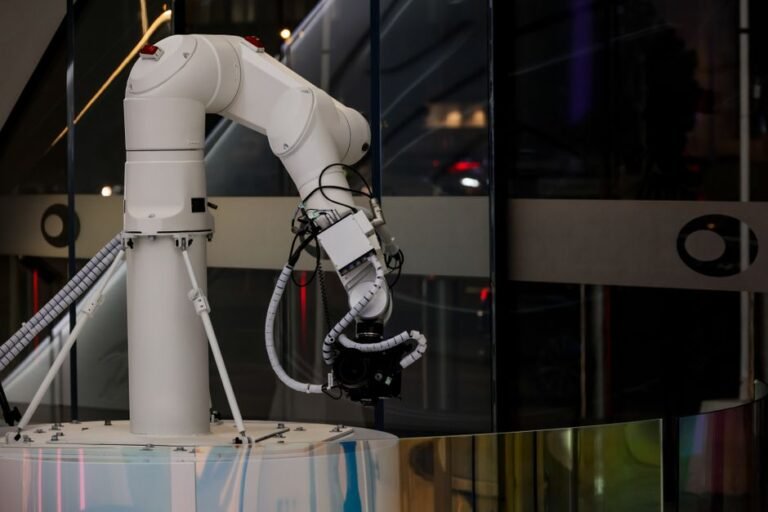
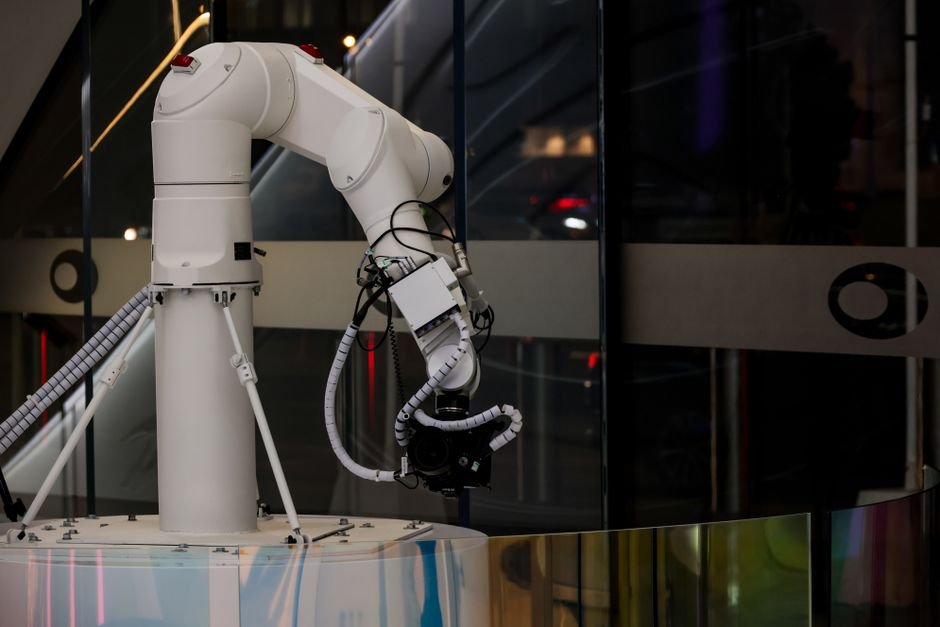
Meta Brain also empowers sophisticated robotic arms like the “LangzuTech Packer.” This innovative system combines Meta Brain’s intelligence with multimodal sensor data to precisely track, grasp, and place parcels of varying shapes and sizes. Through parallel reinforcement learning in simulated environments, the Packer continuously optimizes parcel-placement sequences and loading layouts, significantly boosting sorting efficiency and maximizing carrier space utilization. Recent upgrades in force-control technology have further enhanced its precision for cage-loading operations, allowing the Packer to operate around the clock in multiple JD Logistics parks.
Powering the Future: Building AI Infrastructure
That said, To support this ambitious AI development, JD Cloud is making substantial investments in computing capacity. A strategic partnership with Chinese chipmaker Moore Threads aims to establish a colossal cluster containing 100,000 GPUs. This immense processing power will be dedicated to large-model training, inference, and complex embodied-AI workloads, pushing the boundaries of what intelligent systems can achieve.
Beyond hardware, JD Cloud is also committed to data acquisition, planning to collect over 10 million hours of video depicting real-world human activities over the next two years. This vast dataset will be crucial for training and refining embodied AI systems, enabling robots to understand and interact with human environments more naturally and effectively.
Expanding the Delivery Frontier: Autonomous Vehicles and Drones
Interestingly, JD Logistics isn’t confining its automation to warehouses. The autonomous vehicle network has expanded into crucial night-time delivery routes in cities like Shenzhen, enabling round-the-clock operations and further enhancing delivery speed.
In rural areas, drones are proving to be game-changers. In June, JD Logistics launched a drone delivery network in Zizhong, Sichuan province, serving 78 administrative villages. This initiative has dramatically reduced delivery times, with parcels reaching some remote mountain villages in as little as seven minutes, overcoming geographical barriers that traditionally posed significant logistical challenges.
Investment, Competition, and the Human Element
However, While JD.com has not disclosed the total cost of its five-year procurement program, its commitment is evident in its R&D spending. During the first half of 2026, JD Logistics invested RMB2.3 billion in research and development, a 23.7% increase year-over-year, primarily attributed to continued investment in technology and innovation. This significant expenditure underscores the company’s strategic focus on advanced logistics.
This expansion also reflects a broader trend within China’s e-commerce sector, where major players like Alibaba and Meituan are intensifying competition through investments in fulfillment infrastructure. The shift from delivery subsidies to robust logistics networks highlights the strategic importance of efficient supply chains in the rapidly growing instant-retail market, projected to reach RMB1.2 trillion by the end of 2026.
Meanwhile, Crucially, JD.com is also addressing the human impact of this automation. Founder Richard Liu has openly stated his belief that robots will eventually take over parcel-delivery work. To prepare for this future, JD.com has partnered with approximately 120 educational institutions to retrain workers for new roles, such as robot repair and maintenance. The company currently operates eight robot repair centers in China and plans to significantly expand its robotics after-sales capabilities over the next five years, anticipating the creation of over 100,000 robotics service engineer jobs. This forward-thinking approach aims to ensure a skilled workforce is ready to support the burgeoning automated logistics ecosystem.
Conclusion:
In practical terms, JD.com’s “Physical AI Acceleration Plan” is more than just an investment in technology; it’s a bold declaration of intent to redefine the future of logistics. By seamlessly integrating millions of robots, autonomous vehicles, and drones with advanced AI systems like Meta Brain, JD.com is setting a new standard for efficiency, speed, and reach in the global supply chain. As these intelligent systems continue to evolve and expand, JD.com is not only optimizing its own operations but also shaping the blueprint for how goods will move across the world in the decades to come.
Expert Perspective
From an industry angle, the clearest signal around JD.com AI Logistics is how it may influence delivery. The story reads less like a one-day spike and more like a marker of broader movement.
The next phase will depend on how quickly teams, regulators, or customers react. In practice, that gives JD.com AI Logistics room to reshape expectations across logistics over the near term.
For readers focused on practical impact, the best next step is to watch what changes around systems once attention turns into execution.
Frequently Asked Questions
Why does JD.com AI Logistics matter right now?
The central development is this: JD.com, a titan in the e-commerce landscape, is embarking on an ambitious transformation of its logistics operations, driven by a groundbreaking “Physical AI Acceleration Plan.” This strategic initiative, unveiled at JDDiscovery 2026, aims to integrate artificial intelligence and robotics on an unprecedented scale, promising a future where millions of automated systems work in harmony to deliver goods faster, more efficiently, and across even the most challenging terrains.
What broader change could JD.com AI Logistics signal?
This isn’t just an upgrade; it’s a complete reimagining of the global supply chain.
What should the market watch next around JD.com AI Logistics?
The Vision: Millions of Machines Reshaping Logistics At the heart of JD.com’s plan lies a staggering five-year procurement target: 3 million robots to automate diverse tasks across its network.
Source: https://www.artificialintelligence-news.com/news/jd-com-physical-ai-logistics-3-million-robots/